

When an owner starts thinking about selling, the instinct is to focus on the headline number: what multiple the business might fetch and how big the cheque will be at close. The buyers on the other side of the table are running a different calculation. They are pricing risk, and every unresolved liability, undocumented process, or over-reliance on a single relationship gives them a reason to lower their offer or restructure the deal in their favour. Understanding how sophisticated acquirers assess risk is one of the clearest advantages an owner can have, and it is a large part of what separates the strongest business valuation companies Toronto owners rely on from firms that simply run the numbers. The goal well before an exit is to remove the reasons a buyer would hesitate.
What Buyers Are Really Testing During Diligence
Due diligence is where a preliminary offer either holds or unravels. After a letter of intent is signed, buyers move past management-adjusted figures and examine the financial performance, operations, and risk profile of the business line by line. Most transaction problems trace back to risks that existed long before the sale process began, and diligence is simply the moment they surface. Inconsistent or incomplete financial reporting is the single most common red flag. When monthly results fail to reconcile or cash flow statements are unclear, buyer confidence erodes quickly, and once doubt enters the process a buyer will often widen the review, lower the valuation, or walk away entirely.
Quality of earnings work sits at the centre of this scrutiny. A company can look healthy on the surface while buyers dig into whether revenue is genuinely recurring, whether margins hold steady, and whether earnings reflect normal operations rather than one-time events. When diligence uncovers unusual customer purchasing patterns, margin compression, or working capital gaps, the buyer adjusts the price or asks for holdbacks, earnouts, and indemnities to offset what they found. These outcomes rarely kill a deal outright, but they quietly transfer value from the seller to the buyer.
The Risk Factors That Quietly Erode Value
Certain vulnerabilities show up again and again, and each one carries a measurable cost. The following issues tend to draw the sharpest reaction from buyers:
- Customer concentration, where one client represents a large share of revenue and its loss would materially damage earnings
- Owner dependence, where the business cannot function smoothly without the founder’s daily involvement or personal relationships
- Weak or informal contracts that leave key revenue exposed to non-renewal or easy exit
- Unresolved legal, tax, or compliance matters that a buyer would inherit at close
- Thin or undocumented internal controls and standard operating procedures
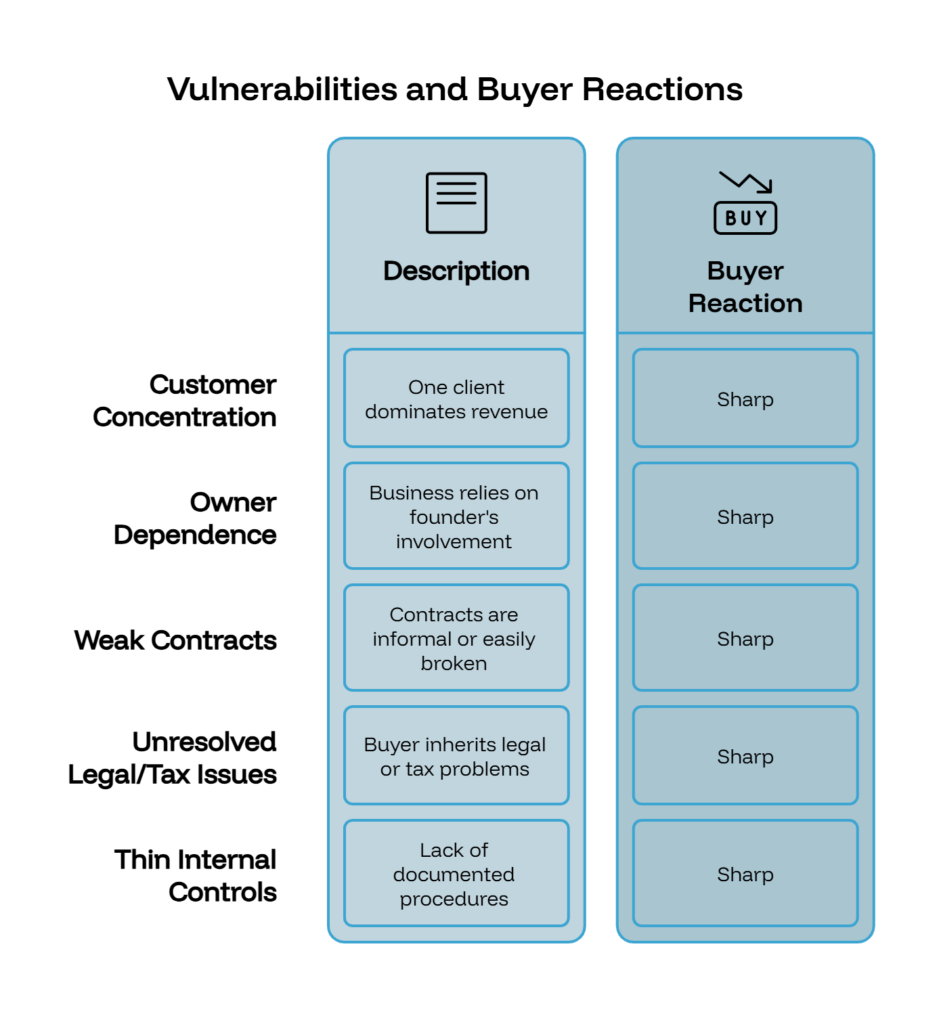
Customer concentration is worth singling out because buyers price it aggressively. A single client above ten percent of revenue typically invites closer review, and dependence that heavy on one relationship can compress the multiple a buyer is willing to pay. The effect intensifies when the relationship runs through the owner personally, since the buyer is acquiring loyalty attached to someone who is about to leave. Owner dependence works the same way. When too much institutional knowledge and decision-making authority sits with one person, buyers apply a discount to offset the transition risk, or they push for extended employment and earnout structures that keep the seller tied to the outcome.
Lowering the Profile Before You Go to Market
The encouraging part is that these risks are visible in advance and can be managed. Reducing reliance on any single customer, ideally starting a year or more before a sale, changes the conversation from applying a discount to negotiating on fair terms. Locking in multi-year agreements with clear renewal and transferability clauses converts open-ended exposure into a defined, predictable window. Building a leadership team that can make decisions independently and documenting standard operating procedures across every major function reduces the founder-dependence discount. Cleaning up financial records so they reconcile cleanly across every source a buyer will examine removes the most common trigger for eroded confidence. Each of these steps also makes the business more resilient and profitable in the years leading up to a sale, so the work is rarely wasted even if the exit timeline shifts.
Preparing this way is not a last-minute exercise, and it is difficult to do well from the inside, where owners are close to the business and easy to overlook the very risks a buyer will flag first. Independent advisory support brings the buyer’s perspective into the room early, identifies the exposures most likely to weaken confidence or trigger a price adjustment, and helps address them while there is still time to move the numbers. Whether the objective is exit and pre-sale planning, value enhancement, or a defensible valuation to anchor negotiations, working through these risks well ahead of a transaction is what lets an owner protect years of hard work and step into the sale conversation from a position of strength rather than concession.